Ideas for keeping
Baby Foot Christmas Tree: A Keepsake Craft to Treasure
How to make a baby foot Christmas tree with a calm, simple printing session, then keep the tiny footprint as part of your family tradition.

A baby foot Christmas tree is one of those wonderfully simple ideas that carries more feeling than effort. Turn a tiny footprint upside down and, suddenly, the narrow heel becomes the top of a tree while the little toes make its widest branches. Add a name and a year, and you have a small record of a Christmas that will never come around in quite the same way again.
The nicest version is not the one with the neatest paint or the most decorations. It is the one that fits into the season you are actually having. This guide keeps the setup calm, explains how to make the print without fuss, and shares a few ways to keep it close after the paper is dry.
Before you begin
Set up for one short, gentle moment
Choose a settled time, put every supply within reach, and ask another adult to help if that makes the moment easier. You will need paper or card, a child-intended printing product used exactly as directed, a firm surface, wipes, a clean towel, and a few spare sheets. The U.S. Consumer Product Safety Commission’s guidance on art materials is a helpful reminder to read labels and keep supplies and small decorations out of reach. Make the print first. The tree details can wait until your baby is clean and comfortable.
Why a footprint makes such a lovely Christmas tree
A footprint already has the shape you need. With the heel at the top and toes at the bottom, it naturally reads as a small evergreen tree. That means the print stays the focus, rather than disappearing under lots of paint, glitter, or extra pieces. It also makes a footprint Christmas tree a kind choice when little hands are curled into determined little fists.
Try not to judge the print too quickly. A soft toe, a tiny smudge, or an uneven edge is not a failure. It is proof that this was your baby, on this exact day. Make two or three prints on plain paper, then choose the one that feels most like them. You can use the others as practice, tuck them into a memory box, or save them for a grandparent card.

How to make a baby foot Christmas tree
Start with a sheet that has plenty of room around the footprint. A wide border will make the finished piece feel calmer, and it leaves space for a frame or a handwritten message later. Place the paper on a firm, protected surface before you bring your baby over. Keep the heel toward the top of the page and the toes toward the bottom, so the finished print will read as a tree.
Follow the chosen product’s directions for preparing the foot and making the print. Support the ankle gently, bring the heel to the paper first, then lower the foot toward the toes in one calm motion. Lift straight up rather than sliding sideways. Wipe the foot straight away, then let the print dry completely before you decide whether it needs any detail at all.
Once dry, add a small trunk just below the toes and a star above the heel. A few dots in muted red or gold can suggest ornaments, but stop while the print still has room to breathe. Write your baby’s name and the year below the trunk or quietly at the edge. If the print itself is clear, you do not need much more. The whole charm is in seeing the true scale of that tiny foot.
Make the printing moment easier
Small practical choices do most of the work. Choose a time when your baby is fed, warm, and not trying to settle for sleep. Put the paper in position before you pick them up, and have another adult hold it still if that helps. A short, prepared attempt is usually kinder than trying to keep a wiggly baby in one place while you search for a wipe or decide where the tree should go.
If the first print is too light, do not press harder next time. Check the directions for your chosen material, reset with a fresh sheet, and try again when you are both ready. A thin, even application and a straight lift tend to preserve the little spaces between the toes better than a heavy layer. There is no need to make the design complicated. The tree can be finished after the printing session, while your baby is elsewhere and the paper is dry.
For a newborn, you may find the foot relaxes most easily when they are lying comfortably with their leg supported. For an older baby, a lap can feel more secure than a high chair or a busy table. Keep the conversation soft, work quickly, and stop if the moment is no longer pleasant. A footprint craft should feel like a small family memory in itself, not a performance anyone has to get right.
Choose the version that suits your family
A footprint tree can be as quick or as lasting as you need it to be. For a card, make the print on a separate sheet first and mount the clearest one onto folded card after it dries. For nursery art, use a heavy sheet of paper, keep the decoration spare, and leave a generous cream border. For a gift, add a small handwritten note on the back about the Christmas when you made it.
If you have an older sibling, they can help with one quiet job after the printing is done: placing a sticker star, adding a few dots, or writing the year with a grown-up. Their role does not need to be large to be meaningful. A footprint tree made beside a bigger sibling’s handprint can become a lovely record of the whole family at that moment.
You can also make the same design more than once over the years. Use the same paper size and write the date in the same place. Seeing the footprints grow from one Christmas to the next tells the story without needing much explanation. It is a family tradition that does not ask for much, which is often the kind that actually lasts.
Keep the details simple and personal
The easiest way to make the tree feel like yours is to add only the details you will still care about later. A first name and the year are usually enough. You might add “First Christmas” if it matters to your family, or write the date on the back with a short note about where the tree stood, who visited, or what made you laugh that day. Those small words can bring the whole season back when the footprint is no longer tiny.
Choose colors that let the print remain visible. A soft green tree, a cocoa-brown trunk, and a little rose or gold detail are more than enough. If you are using a dark background, make a sample print first, because the smallest toe shapes are the parts most likely to disappear. A pale card with one carefully chosen color is often the clearest and most timeless choice.
If the design does not come out as planned, keep the print anyway. You can trim it into a smaller card, place it in a simple frame, or save it with the year written on the back. The original print is the irreplaceable part. The tree is simply a sweet way of helping everyone see what it was.

Give it a place after Christmas
A footprint tree becomes more meaningful when it has a home after the decorations come down. A paper version can be slipped into a baby book, stored flat in a keepsake box, or brought out as part of next year’s decorating. If you framed it, a small shelf or nursery wall lets the print remain part of everyday life rather than becoming something you only see once.
For grandparents or family who live far away, one print can become several thoughtful gifts. Photograph the original before adding any details, then make copies to mount on cards or tuck into a holiday note. A few words about the day, written in your own hand, can make the gift feel even more personal. The original can stay safely with your own family story while the copies travel where they will be loved.
There is also no rule that says every print needs to become a public display. Some of the sweetest ones belong in a labeled envelope with the year, a favorite photo, and a note about the season. Future you will understand exactly why you saved it, even if the tree never sat in a frame.
Keep the original safe
Before you trim, frame, or mail anything, take a quick photograph or scan of the dry print. That gives you a simple backup and makes it easy to create a second card for someone who would love one. Then keep the original flat, clean, and dry, away from direct sunlight. The Library of Congress’s paper-care guidance offers useful basics for protecting paper mementos that you want to revisit later.
If the print is headed into a frame, use a mat or leave a border so the ink or paint does not sit directly against the glass. If it is going into a keepsake box, place it in a clean folder or photo-safe sleeve rather than under heavier objects. Write the date now, while it is still fresh. The year will become part of what makes the piece so special when you look at it again much later.
Turn one print into a Christmas tradition
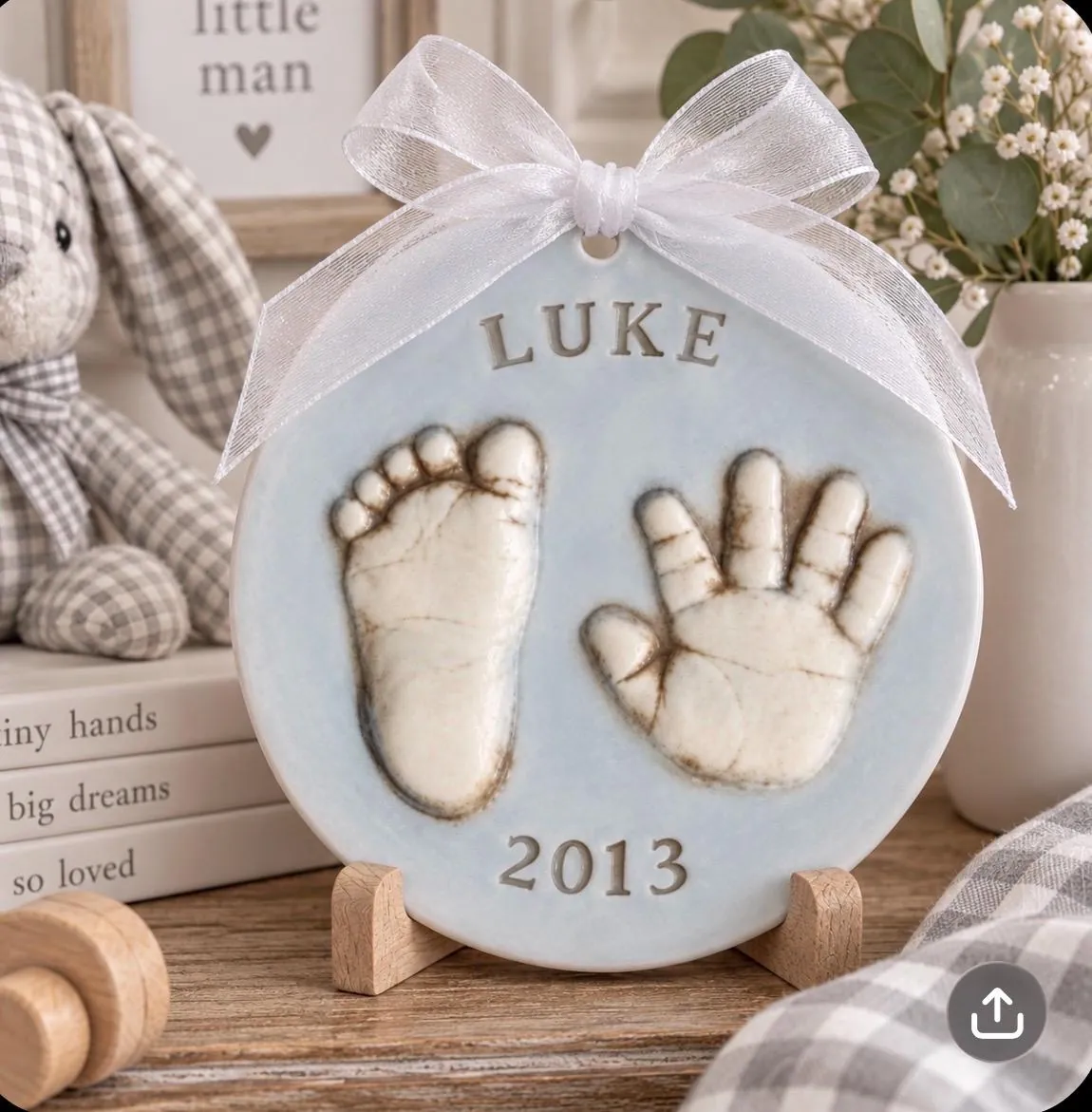
A paper footprint tree is perfect for a calm afternoon at home. Sometimes, though, the print is the one you know you will want to bring out every year. A handmade ceramic ornament gives that impression a more permanent place in the holiday box, ready to hang alongside the lights and the family favorites.
The Baby Handprint Company sends an at-home mold kit so you can make the impression in familiar surroundings. Debbie then shapes and finishes each ceramic keepsake by hand. The at-home process explains how it works, and the handprint and footprint ornament collection shows the different pieces that can become part of your tree. If you would like more paper-and-print ideas first, the Journal’s baby footprint craft guide is a gentle place to keep exploring.
Let the tiny foot be the point
It is easy to feel that a first Christmas craft should look polished enough for a photograph. It does not. The footprint is already the thing you will want to see again: the rounded heel, the little toes, the scale that changes almost before you notice it. A simple tree shape only helps that memory take center stage.
Choose one calm moment, make a few prints, and keep your favorite. Whether it becomes a card, a framed page, a memory-box memento, or an ornament you hang every year, the real work is already done. You have saved a detail that will be impossible to recreate later.
Questions parents ask
Baby foot Christmas tree FAQs
How do you make a baby footprint Christmas tree?
Make one clear footprint on paper or card with the heel pointing up and the toes at the base. Once it is dry, add a small trunk below the toes, a star above the heel, and just a few simple decorations. Put the name and year where they will not cover the print.
What should I use for a baby footprint craft?
Choose a product that is clearly intended for children and follow its label and directions. Set up the paper, wipes, and a clean towel before you begin, then keep the printing moment short and calm.
Is a footprint easier than a handprint for a baby Christmas craft?
For many babies, yes. Little feet often stretch more readily than curled hands, so a footprint can be a gentler first try. Make a few prints and keep the one that feels most like your baby rather than trying to force a perfect result.
How can I preserve a baby footprint Christmas tree?
Photograph or scan the print once it is dry, then store the original flat in a clean, dry place away from direct sunlight. A frame, a photo-safe sleeve, or a memory box can all work well, depending on how you want to revisit it.
Can a baby footprint become a Christmas ornament?
Yes. A paper version can be mounted onto sturdy card and hung with ribbon, while a handmade ceramic ornament can preserve the impression itself as part of the family decoration box for years to come.
Keep reading
Related posts


